
1956
01/Drivers’ championship
8 rounds


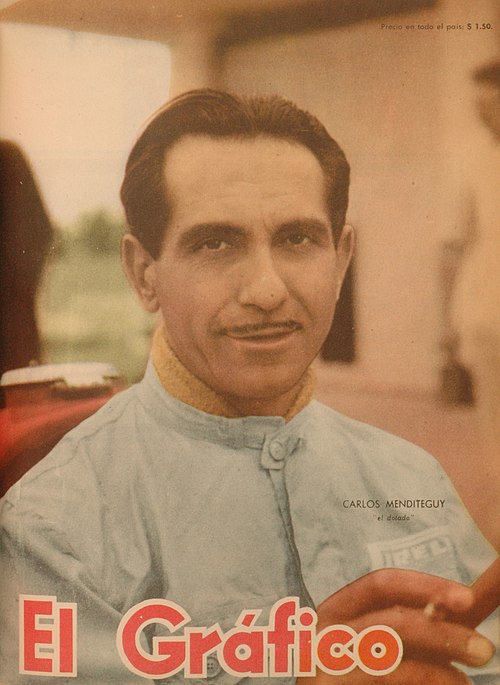


Read from the season’s final standings row, never summed from the race results. 58 of 85 entries in this table carry no championship position and are ruled below the placed field, ordered by points. 3 of 85 totals are fractional, which is the sport’s own arithmetic (shared drives split a score, and a race stopped short pays half points), not a rounding artefact.
02/Constructors’ championship
before 1958
No constructors' championship in 1956. The title for constructors was first awarded in 1958. The drivers’ championship began in 1950, so the 8 seasons from 1950 to 1957 were run with a title for drivers and none for the cars they drove. The constructor a driver raced for is still recorded, and it is printed in the Car column above; what does not exist for 1956 is a championship between constructors. This is the history of the sport, not a gap in the archive.
03/Calendar
Every race
| Rnd | Date | Grand Prix | Circuit | Where | Winner | Car | Cars |
|---|---|---|---|---|---|---|---|
| 1 | JAN 22 | Argentine Grand Prix | Autódromo Juan y Oscar Gálvez | Buenos Aires, Argentina | Luigi Musso | Ferrari | 15 |
| 2 | MAY 13 | Monaco Grand Prix | Circuit de Monaco | Monte Carlo, Monaco | Stirling Moss | Maserati | 18 |
| 3 | MAY 30 | Indianapolis 500 | Indianapolis Motor Speedway | Indianapolis, USA | Pat Flaherty | Watson | 34 |
| 4 | JUN 3 | Belgian Grand Prix | Circuit de Spa-Francorchamps | Spa, Belgium | Peter Collins | Ferrari | 15 |
| 5 | JUL 1 | French Grand Prix | Reims-Gueux | Reims, France | Peter Collins | Ferrari | 19 |
| 6 | JUL 14 | British Grand Prix | Silverstone Circuit | Silverstone, UK | Juan Fangio | Ferrari | 28 |
| 7 | AUG 5 | German Grand Prix | Nürburgring | Nürburg, Germany | Juan Fangio | Ferrari | 22 |
| 8 | SEP 2 | Italian Grand Prix | Autodromo Nazionale di Monza | Monza, Italy | Stirling Moss | Maserati | 26 |
Both championship tables on this page are read from the season’s standings rows at round 8, the last round loaded, and neither is derived by adding up the race results. That distinction is the whole point: for most of the sport’s history only a driver’s best few results counted toward the title, a race stopped short paid half points, and a driver could be excluded from a championship he had scored in, so a table built by summing the results column would disagree with the championship as it was actually awarded. Positions are the source’s own; where it recorded none, the row prints a dash and sits below the placed field rather than being given a place it never held or dropped from the page. A points total is printed as it is stored, to two decimals where it needs them, because the sport has awarded half points and split shared drives since the 1950s and those fractions are real. The calendar is every round in the archive for 1956, in round order, with the winner taken from the classification code the source prints rather than from its sort key; three of the 1,161 races loaded were won by a shared car, and for those the calendar names one driver while the race classification credits both. The Cars column counts the rows in each race’s classification, which includes cars that retired, so it is entries with a recorded result rather than a count of cars that took the start. The drivers and constructors counted in the masthead are those that appear in a race result for 1956, not those that entered. There is no constructors’ championship for 1956: the title was first awarded in 1958, and its absence here is history rather than missing data. 1956 is complete: all 8 rounds are loaded and both tables are final.